
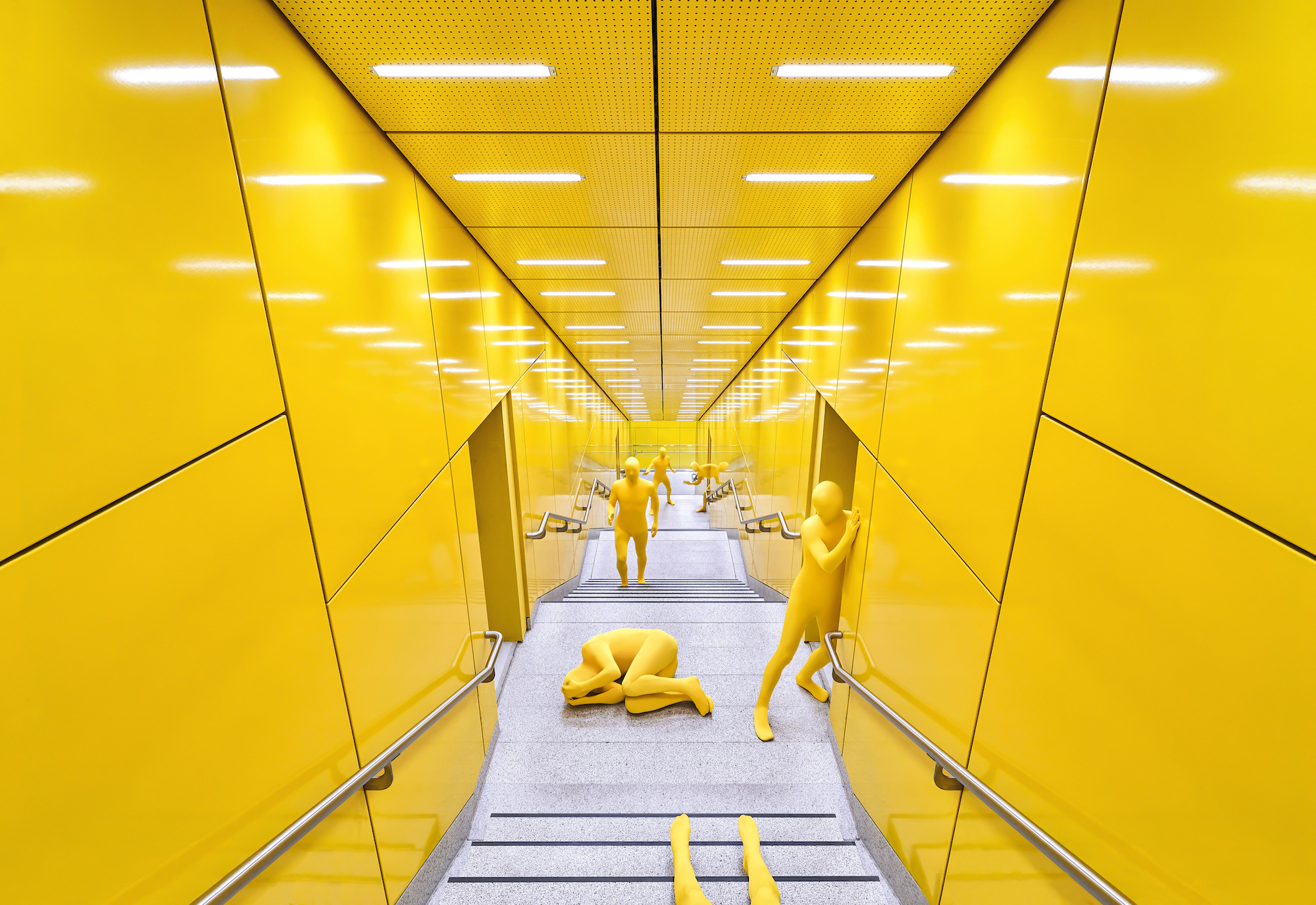
Nick Frank works at the intersection between art, architecture and industry, creating visual narratives that strip his subjects back to their essence. The Munich-based photographer speaks to Cultural Union about the practical and artistic tenets of his work.
If there is a photographer who has mastered the compelling magnetism of liminal spaces to shed light on our world, it is Nick Frank. The Munich-based photographic artist has a rare talent for showing us both the beauty and the strangeness of objects or architecture, stripping them of their immediate context to make us examine them anew.
In VX4, a helicopter is poised like a praying mantis, devoid of surroundings to show us what an alien object it is. In Tomorrowland, a coned building juts into a cobalt sky, a turret we could have walked past a thousand times without finding remarkable, yet through Frank’s lens, we see it for the striking, sculptural oddity that it is. That some of these images are commercial commissions rather than purely artistic endeavours only adds to the sense that Frank has staked out his claim on a remarkable, intention-laded photographic aesthetic.


We sat down with Frank to learn more about the practical and artistic considerations underpinning his work. Here’s what he has to say:
What is your overarching mission?
With my photography, I present my subjective view of things. It is an attempt to reduce a subject to the extent that only the essence of what I want to showcase remains. The subject of the photography can be colour, shapes, structures, or other architectural features, which I try to reduce as much as possible so that the viewer is not distracted. Personally, I find it interesting when a viewer does not directly understand what they are viewing and a question arises.

In your Anonymous series [top], eerie figures populate a surreal yellow space. What are you exploring here?
Conformity is something very intriguing to me, possibly because I am German, where everything is governed by rules, standardised and calibrated. So maybe it is a comment about Germany in general – with a little twinkle in the eye.
I find it interesting when a viewer does not directly understand what they are viewing and a question arises.
Nick Frank
In the Around the World series, a woman gazes into an unreal horizon, sometimes beautiful, sometimes unsettling. Please describe the thinking behind this series and how it was constructed.
With fine-art photography, I only believe in planning and concepting things to a point. Art is often driven by intuition rather than a strict plan – the best creations often come from spontaneity, allowing emotions and instincts to guide the process. This freedom breaks boundaries and brings art to life. I often notice this when visiting galleries and observing the works of other artists. It often feels very contrived, as if the concept or idea was added afterward, perhaps by the gallerist. There’s a sense that the artwork was shaped to fit a particular narrative or concept, rather than being driven purely by the artist’s intuition.

Your portfolio includes a mixture of commercial work and artistic ‘free projects’. How do you select your destinations or themes for your free projects, and what is next?
I don’t follow a plan on how to select locations. It is more of a feeling. Sometimes you are drawn towards something. This can be colours, shapes or even people – though I have to admit that, especially with architecture, modernity is always more appealing to me than classic architecture. So, that is what I am aiming for.
I stopped doing free projects for a couple of years – maybe because I got sucked into this world of commercial photography, but also because someone copied quite a lot of my images – around 100, not only by location, subject and angle but also retouched in the same way. That was a very frustrating experience. And there was nothing I could do about. So, I stopped.

But two weeks ago, I bought a new camera, just for the purpose of travelling and shooting free projects, so I think it’s time to start again. Let’s see what locations I will come up with. Denmark is always a good start – I love the architecture there: interesting shapes and colours. Very fluid and organic. Not like here in Germany, with all the Bauhaus.
What role does AI have in your work, and how do you believe it will impact the future of photography?
As a fine-art photographer, I am not a fan of AI as results are mostly based on someone else’s work. In art, it is critical to follow your own path, experiment, fail, and learn on the way. This part is removed when you are using AI. After a while, you also get a good understanding of what AI images look like – so you can identify them easily. I am not talking about just the hands!

However, as a commercial photographer, I find AI very helpful, as it is a great tool for building mock-ups and showing a client in what way you want to drive your upcoming shoot. It’s also very helpful in creating backgrounds. Generative fill in Photoshop is another great AI tool. It reducing your retouching time by a lot.
You have an impressive roster of clients, from Apple to aerospace companies. What are the qualities in your work that attracts these clients? What advice do you have for other photographers as to how to build these relationships?
I think the quality of work one should aim for is not just the final product you are delivering – it is the sum of all actions involved in a project. One of my big assets is speed. I am always there for the client at whatever time needed. I will respond promptly. I will deliver retouching fast. My goal is to have a flawless experience for companies who want to work with me. This experience also involves guidance and consulting, as a lot of clients feel a bit lost on how to approach a shoot. I help with picking locations; I’ll write shot-lists and even help to concept imagery if needed. I also give clients options on where and how to use images and how they can build assets. Photography is not only about taking pictures anymore. You need to deliver a package to make it easy to work with you. Clients are busy – they need to get stuff out of the way.
