
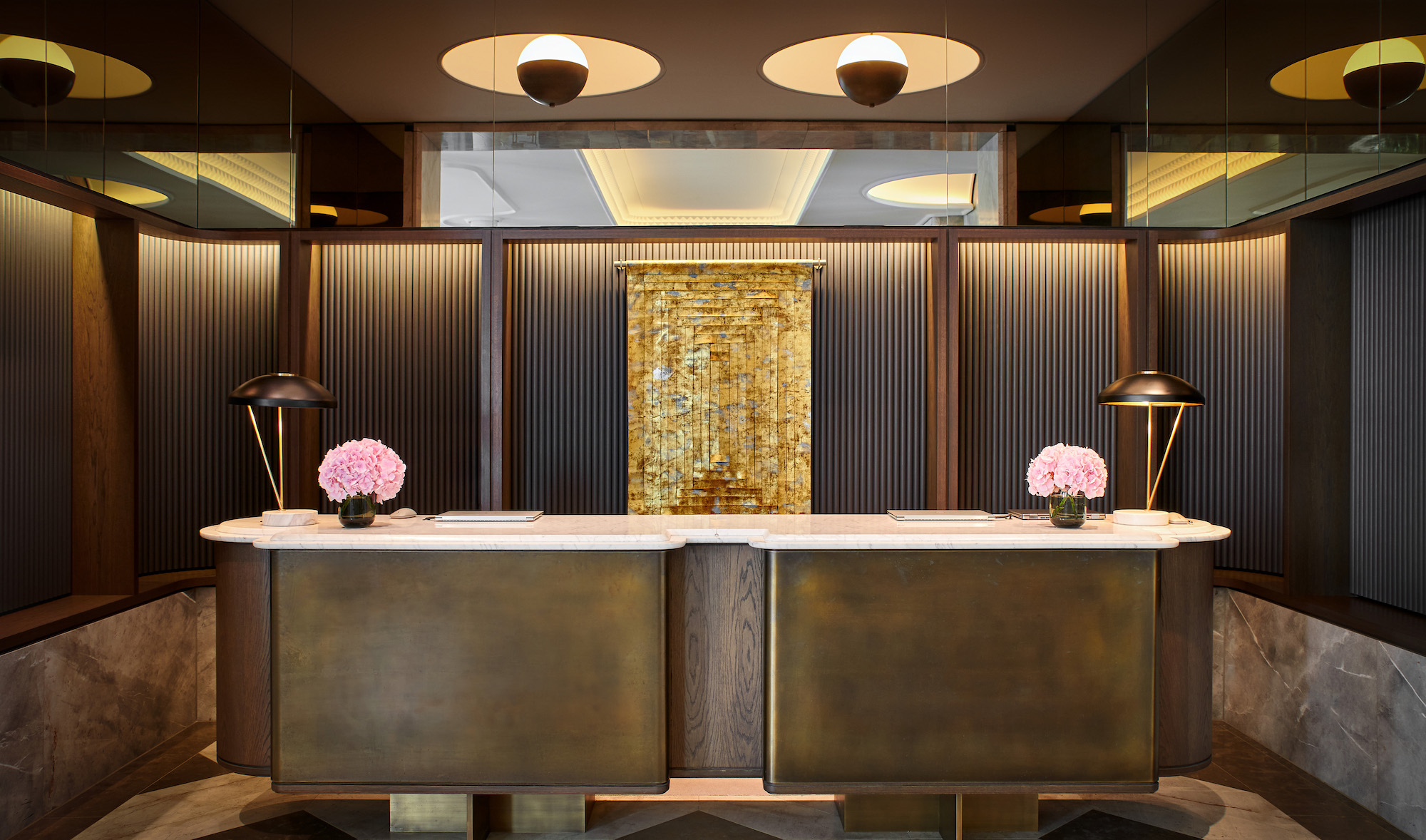
From Four Seasons to Cunard, the bold art collections of London curation studio Double Decker have redefined the world of hospitality. As the studio marks its 15th anniversary, its founders Melita Skamnaki and Wilhelm Finger speak to Cultural Union about their artistic and commercial vision.
If you’ve stepped into a hotel recently and noticed that the art collection was particularly well put together, there’s a good chance it was curated by Double Decker. Formed 15 years ago by Wilhelm Finger and Melita Skamnaki on a flight to their first commission at Brazil’s Oscar Niemeyer Museum, the London-based studio has been at the vanguard of a hospitality revolution that has seen art take its rightful place alongside interior design and architecture as one of the fundamental markers of a successful project. As the duo point out: “It’s not having an extensive collection that counts – it’s having it properly curated as a cohesive, thought-out body of work.”


We meet at Double Decker’s London headquarters in a period building in Soho – an Aladdin’s Cave of treasures from their 15 years of curating and collecting. A fabulous 1960s Danish rosewood cabinet frames one wall, laden with objects and art books from across the world that provide a clue to their twin spiritual homes of contemporary and mid-century art. The chairs alone are unimpeachably cool – an Oscar Niemeyer armchair stands casually in a corner, a relic of their work in Brazil, while a pair of 1970s Giancarlo Piretti Plia chairs greet you in the hallway. The studio buzzes with artists, designers, project managers and creatives. But what, exactly, goes on here?
“We are a curation studio,” says Skamnaki. “Curating is at the core of what we do. But we also describe ourselves as consultants because, unlike traditional curators, we understand branding.” Finger expands on this: “An art consultant can tailor a collection for a brand like Four Seasons or Mandarin Oriental. They understand the hierarchy of brands in a way curators often don’t.”

The distinction is important as it lies at the heart of the studio’s success. While Finger and Skamnaki have curated for many of the world’s great cultural institutions, they also have a background in advertising, music and communications. This gives them an innate understanding of how to read a brand’s DNA and to build collections that align with it. “A curator often focuses solely on their own vision,” says Finger, “whereas we ensure the collections we create are future-proof. We don’t want something that feels outdated in two years – we aim to create a legacy for our clients.” He adds: “Advertising taught us speed and responsiveness. Campaigns have tight deadlines, and we bring that same energy to our projects.”
“We ensure the collections we create are future-proof – we aim to create a legacy for our clients.”
Their transition into professional art curation began when the pair met on a course at the Design Museum in London. The commission to curate an exhibition at the Oscar Niemeyer Museum came soon after, during which they discovered they made a good team, and a new exhibition in Athens followed.

On their return, an architect friend asked them to curate art for a hotel in Oxford, and the young studio felt an immediate affinity with hospitality curation. “What’s exciting about curating for hotels is that the audience doesn’t expect the art,” says Skamnaki. “In a gallery, people go to see a specific artist. In a hotel, they’re surprised by the collection.”


This element of surprise and of challenging expectations remains central to their approach. During initial discussions with Rosewood about curating the art collection for their landmark new hotel in Munich, Double Decker won the commission by demonstrating their lateral, unexpected approach to the brief. “We worked with a ceramic artist from the Royal College of Art (RCA) who had found a tiny old Bavarian souvenir,” says Finger. “He scanned it and 3D-printed a beautiful ceramic sculpture from it, enlarged to 80 cm. It was a contemporary take on a historic object, and the curatorial story – of a Scandinavian artist harnessing a Bavarian object for an RCA show in London – showed a level of sophistication that the client loved.”

Rosewood Munich now possesses over 400 pieces of original fine art curated by Double Decker and is a prime example of what can be achieved when a client entrusts the curators with the latitude to make bold artistic choices. A riveting picture by Michael Baumgarten exudes both Rococo exuberance and neo-surrealism. A series of original works by Thomas Trum is contemporary in the execution of their continuous, diaphanous lines, while their colour palette of oranges, greens and pinks recalls the iconic 1972 Munich Olympics – one of many subtle references that anchor the art to the building’s architecture, and the hotel to its city.


Perhaps it’s their work on Cunard’s Queen Anne, though, that stands out as one of their most ambitious projects to date. The flagship cruise liner, launched in 2024, is Cunard’s first new addition this century, and the shipping line – conscious of the historic opportunity to redefine cruise shipping – assembled a creative team from the global A-list. It included the legendary New York designer Adam Tihany as creative director (who both Skamnaki and Finger pay tribute to as a mentor), David Collins Studio and Richmond International as interior designers, and Double Decker as art curators. With over 4,300 pieces of fine art, it’s the largest art collection anywhere at sea. “They wanted a fresh, non-traditional approach,” says Skamnaki.
“Guests live and breathe the ship for weeks, even months,” says Finger, describing how the ship becomes a genuine home from home during that time, with the art becoming an important part of the fabric that builds memories. “There need to be many layers of discovery on each piece,” says Skamnaki. “The next time you see it, you might notice something else. And it helps give each area a different narrative and experience.”
For many of these areas, Double Decker commissioned artworks from established artists such as Ian Kirkpatrick, who created the stunning kinetic brass installation in the ship’s central space, the Grand Atrium – a monumental piece spanning three floors.

But one of the groundbreaking aspects of the ship’s art collection is the proportion of young, next generation talent. “This juxtaposition of emerging artists together with established ones was a special combination,” says Finger. “It gives such a strong balance to the overall artwork collection.”
“This juxtaposition of emerging artists with established ones was a special combination. It gives such a strong balance to the overall artwork collection.”
Double Decker handpicked artists from three of the world’s most prestigious art colleges – New York’s Parsons School of Design and London’s Central Saint Martins and RCA. The studio arranged for each artist to visit the Cunard Archives in Liverpool for research and inspiration. “We briefed them, and mentored them throughout the process, but we also gave them the freedom to express their own artistic voices,” says Skamnaki.


Another theme to be found across Double Decker’s projects is the close relationship the studio builds with talent local to the regions they are working in. For their art collection at the Four Seasons Marrakech, Double Decker collaborated closely with local artisans and ceramic studios to create pieces that reimagined traditional Moroccan craftsmanship. “We challenged them to think differently,” says Finger. “Can we change the glaze? Can we make it pink and yellow? It’s about keeping the essence but giving it a contemporary sensibility.”
On other projects, the studio goes a step further, designing pieces in-house – as with the sculpture they created for the luxury expedition ship Seabourn Pursuit. “The travellers are on these incredible, once-in-a-lifetime journeys – sometimes weeks without touching civilization,” says Skamnaki. “The art has to resonate deeply.”
In response, the studio created Magical Sky – a beautiful black, spherical sculpture that creates the captivating optical illusion of an infinite sky.

“The idea was to challenge the guests,” says Finger. “It’s not easy to surprise people who have ‘seen it all.’ They might go from studying star charts to diving 300 meters in a submarine. The art needed to match that level of wonder.”
As the studio celebrates its 15th year, one gets the impression they are hitting their stride and relishing the pace. At a party to mark the event, guests from across the artistic, design and hospitality industry are effusive in their praise for a studio that is redefining hospitality curation while never forgetting their mentorship of artists.

Plaudits also come from their many collaborators. Adam Tihany – who is credited as inventing the entire notion of restaurant design – tells us: “I love their energy, their talent and their vision. Double Decker is my favourite company to work with and I only have great things to say about them.” And Lewis Taylor, design director of the great David Collins Studio (who designed iconic restaurants such as J Sheekey and the Wolseley, and who worked with the studio on Queen Anne), says: “Our spaces are so successful in large part because Double Decker was involved right from the start. Every piece feels purposeful, connected, and part of the ship’s design DNA.”
What seems certain is that there’s unlikely to be any let up in the pace of work for the in-demand studio. Just this year, hotel openings include Four Seasons Rabat and Kennedy 89 in Frankfurt, with next year includes a new St. Regis on Bond Street; and while Finger and Skamnaki remain the leads on all of their projects, the studio continues to grow to reflect the increased workload.


Turning 15 also provides an opportunity for the founders to reflect on a hospitality industry that has evolved significantly since they started. “Hotels are far more open to art now,” says Skamnaki. “And the guests are more engaged with it.”
Finger adds: “It’s not about matching the art to the sofas anymore. There’s a far higher level of sophistication. When you see a very good hotel, you see there is an attention to detail. And when there’s a good art curator, it means the hotel cares about their guests.”
When reflecting on what the next 15 years might hold, both founders are adamant that their ethos of experimentation and desire to keep pushing at the boundaries of what is possible will remain. “And we will always keep nurturing young artists,” says Skamnaki. “It’s one of the most important and exciting parts of what we do.”