
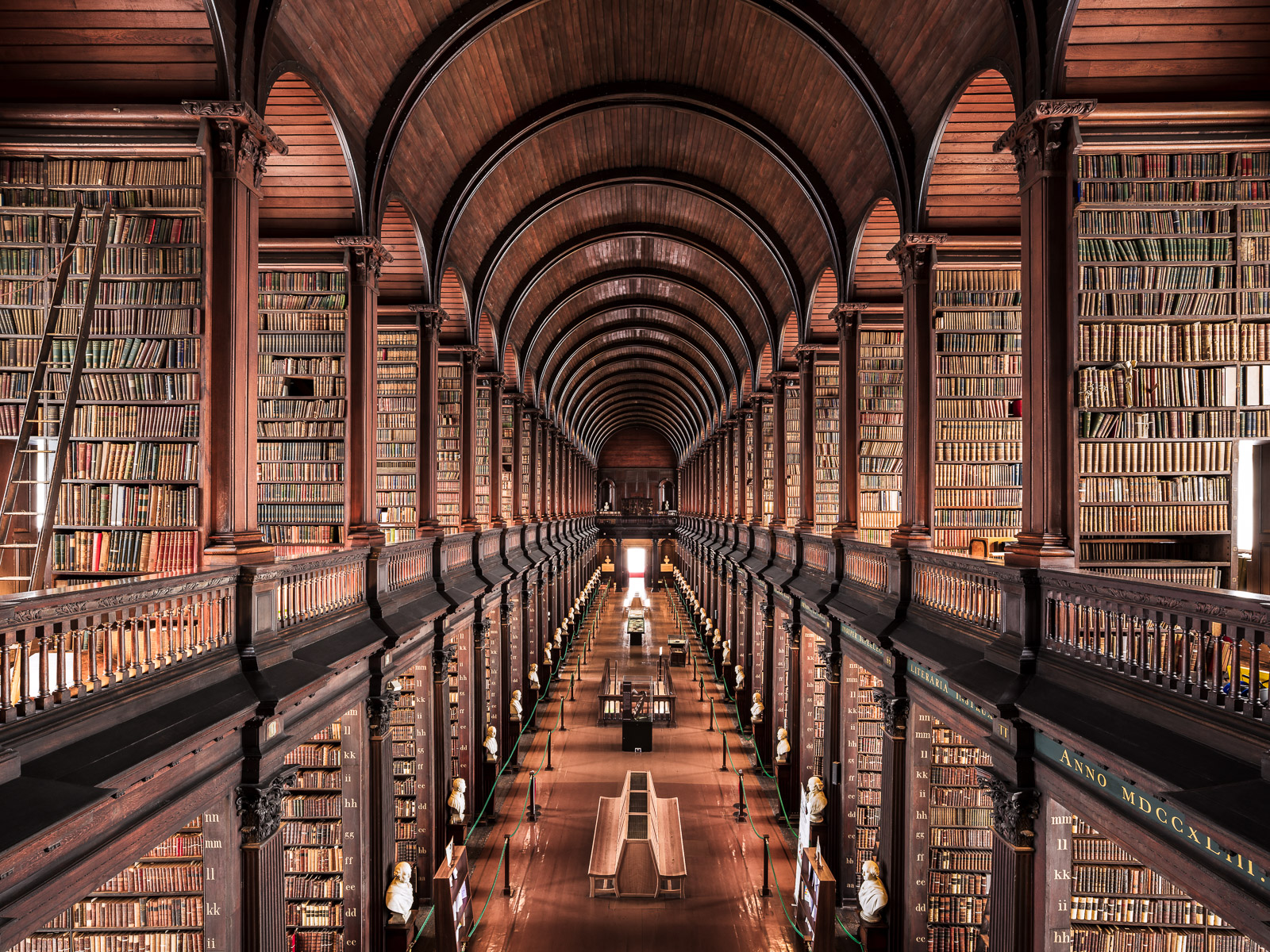
Over the past few decades, French photographer Thibaud Poirier has assembled an extraordinary series of images of the world’s most beautiful libraries. He speaks to Cultural Union about capturing their power and awe.
There is something almost transcendental about seeing a building through the lens of a skilled architectural photographer, as if glimpsing its soul through the mind’s eye of its architect, stripped of its daily penumbra and chaos. And there are few architectural photographers more skilled than Thibaud Poirier.
While the span of Poirier’s work is broad, it’s his ability to capture scale and a sense of awe that sets him apart, particularly when chronicling Modernist architecture and public spaces such as libraries and churches.
1. Bibliotheque de l’Assemblee Nationale, Paris, 1796

His libraries, in particular, offer up their beauty through Poirier’s mastery of symmetry – a potent tool that unlocks the power of a building and that is often difficult to see with the naked eye. “Symmetry holds a profound power over the viewer, evoking a sense of order, balance, and harmony. It creates visual stability that draws the eye into the composition, instilling a sense of calm and equilibrium,” says Poirier. “In my library and church series, I aimed to showcase these spaces uniformly, using a central viewpoint and selecting buildings with symmetrical attributes to enhance their inherent beauty and create a powerful, cohesive narrative.”
2. Grimm Zentrum Library, Berlin, 2009

And while the libraries captured by Poirier differ widely, from the Baroque splendour of Portugal’s Biblioteca Joanina to the almost clinical minimalism of City Library in Stuttgart, they all suggest a reverence of books and ideas. “Each library is a testament to the cultural and historical context in which it was built, reflecting the aesthetic and intellectual values of its time,” Poirier says. “However, beyond their visual differences, they all embody the same purpose: to transmit knowledge from one generation to the next. This is evident in their carefully designed spaces, which are tailored to foster learning and contemplation.”
Symmetry holds a profound power over the viewer, evoking a sense of order, balance, and harmony.
Thibaud Poirier
Poirier adds: “The sensory experiences within these libraries—such as the smell of old books, the unique acoustics, and the thoughtful lighting—create a familiar atmosphere of respect and wonder, regardless of the library’s architectural style.”
3. Biblioteca Joanina, Coimbra, 1728

Poirier’s library images are some of the most extraordinary we have seen, and it’s clear that libraries possess certain attributes that makes them especially compelling subjects.
“It is because they are rich with history, architecture, and the promise of knowledge,” Poirier explains. “As repositories of countless stories and ideas, they possess a unique aura that invites exploration and contemplation, making them timeless and captivating, even in this digital age.”
And when asked which of the many libraries he’s recorded affected him most deeply, he says: “I would have to say the Bibliothèque Sainte-Geneviève in Paris. Architecturally, it’s one of my favourites and was the first library I photographed. Its beauty and historical significance left a lasting impression. The mix of stone, cast iron, and wood gives it a noble yet industrial feel, embodying the spirit of the mid-19th century.”
4. Bibliothèque Sainte-Geneviève, Paris, 1850

There’s a curious mixture of stillness and drama in Poirier’s work, not unlike theatres or cathedrals moments before the performance begins; and Poirier skilfully captures that sense of higher ideas and awe. “My focus lies in telling a compelling story through composition, lighting, and perspective,” he says. “In my work, architecture serves as more than just a backdrop; it becomes the protagonist, conveying deeper truths about society and the human condition. Each photograph aims to capture the soul of the space, reflecting its physical, emotional, and conceptual significance.
“By thoughtfully composing my shots and playing with light, I strive to evoke a sense of wonder and contemplation.”
5. Bibliothèque de l’Hotel de Ville de Paris, Paris, 1890

6. Stadtbibliothek, Stuttgart, 2011

“As repositories of countless stories and ideas, they possess a unique aura that invites exploration and contemplation.
Thibaud Poirier
Galerie Diane, Fontainebleau, 1605–1826

Bibliothèque du CRDM, Paris, 1930

Bibliotheque Nationale de France, Salle Labrouste, Paris, 1868

Trinity College Library, Dublin, 1732

Read more: Interiors | Design | Pro Q&A | France | Photography | Thibaud Poirier