
Across the design industry’s leading event, renowned decorators and leading brands looked to nature and the past to mollify the current moment, while independent talents harnessed history and natural material to set their sights on the future.
Milan Design Week remains the international furnishing industry’s main event. Taking place this year from 20–26 April, the massive city-wide happening centres on its dizzying-scale trade fair Salone del Mobile.Milano, but extends far beyond to every reach of the metropolis. Hundreds of showrooms, converted industrial sites, palazzos, churches, schools, plazas and even public pools are reutilised for temporary week-long exhibitions, collectively setting the tone for where design is headed in the year to come.

With the world in the turmoil that it is, Milan Design Week reflected the impact of the many conflicts of our time as well as the economic repercussions on the industry itself. Rather than direct commentary, this manifested as a sense of exuberant refusal to be deterred – a sense of business-as-usual as a form of protest.
Up-and-coming practitioners, students and smaller brands showcased new wares at a bevy of scrappy group exhibitions, demonstrating a continued engagement in clever explorations of material, form and application. While many of these fledgling designers and companies seemed to utilise history as a jumping-off point, established brands and cultural institutions appeared to mainly focus on the past as a means to better understand the present.
Independent Talents Experimenting

Alcova, the mother of these collective exhibits, presented a whopping 131 exhibitors across the repurposed Baggio Military Hospital and the iconic Franco Albini-designed Villa Pestarini. As Milan continues to uncover its own rich architectural heritage, exhibitions staged in historically significant locales were even more prevalent this year. Among showcases mounted by top schools, including Design Academy Eindhoven, HEAD Geneva, and London’s Architectural Association at Alcova, were a slew of smaller, up-and-coming and second-act talents.
Of note was Studio Lugo’s one-off Resonance furniture collection: furniture pieces championing the imperfections of alpaca metal and celebrating the unpolished traces of handwork. In a similar spirit, local design and research studio Parasite 2.0 collaborated with Italian stone atelier Bianco67 on a capsule collection that embraces the idiosyncrasies of natural material such as travertine but also showcases the potential of new processing technologies. The speculative designs were unveiled as part of Salone del Mobile.Milano’s inaugural Raritas exhibit, a new section of the fair dedicated to the ever-stratified collectible design market.


Also at Alcova was the recently established New York studio MA-MA’s Waiting Room collection – three adaptable furnishings that, within the constraints of a tight material palette, can transform or come apart to accommodate one’s changing needs over the course of a day. Across town, international creative agency Simple Flair mounted the latest edition of their Convey showcase, vertically, across a 1950s office building. Here, Los Angeles duo Joshi / Greene displayed its Shaker-inspired Rail System. A similar kit-of-parts concept conducive to the growing need for flexibility in our increasingly compact homes, the design incorporates items such as chairs, mirrors, and shelves hung up out of the way, almost as the art one might hang on their walls, and taken down when needed.
Cohering Vintage and Historically Cued Contemporary Design

The ever-emergent paradigm of pairing the current moment with the past was a common theme this year. A slew of contextualised domestic displays staged by interior decorators in intimate apartments – some more historically potent than others – deftly intermixed rare antique and vintage pieces with contemporary collectible designs (many of which distil from early 20th-century styles) to evoke personal, nostalgic, and even escapist narratives. Many this year went crazy trying to get into a rarely accessible private “total-work-of-art” apartment designed by Osvaldo Borsani in the 1930s. On view was Interni Venosta’s tightly curated, high-end offering of historically referential designs.

French purveyor Yves Salomon Éditions tapped sought-after New York interior decorator Michael Bargo to compose the Kentucky, Paris: An American Private Room display in an intimate apartment setting. Comprising Midcentury Modern pieces by the likes of Paul Frankl and Eero Saarinen but also Bargo’s own matching-style designs, the staging called to mind Bargo’s desire to represent the United States as a quilt, not just a single flat fabric or monoculture. To commemorate its 50th anniversary, French fragrance brand L’artisan parfumeur called on celebrated, “unconventional” antiques dealer Antoine Billore to do his thing in another apartment. Always filtering references from the past, boutique Los Angeles producer De Troupe teamed up with local practice studioutte and fabric brand Dedar to mount a small but impactful environment inspired by the golden age of cinema. The Camera Fissa installation debuted De Troupe’s new six-piece Edition no.1 furniture and lighting collection.
Transportative Brand Activations

A big debate at Milan Design Week 2026 was the validity of the now well-worn brand activation model. Major luxury (but also, increasingly, mid-market) companies from sectors including fragrance, beauty, automotive and tech, have gotten in on the game in the post Covid-19 era. For many, there’s an overwhelming feeling that these largely immersive displays are mounted to hold the attention of a captive audience while not adding anything substantive to the conversation. Where some of these were successful, however, was in demonstrating – even if from a speculative standpoint – the use of a new product or didactically recounting the valuable, “learning moment” story behind its development.
This year, the big fashion houses that have made the week an important brand exercise for over a decade – some launching home accessories and others just “showing up” – were less boisterous and arguably more intentional than at past editions. The Hermès showcase was far less elaborate than in previous years yet still visually and viscerally enticing. To unveil new editions to its Objet Nomad collection, Louis Vuitton introduced a large colour-blocked platform that curls up in the courtyard of its preferred palazzo but not much else. Several brands adopted a papery, book-worm approach.

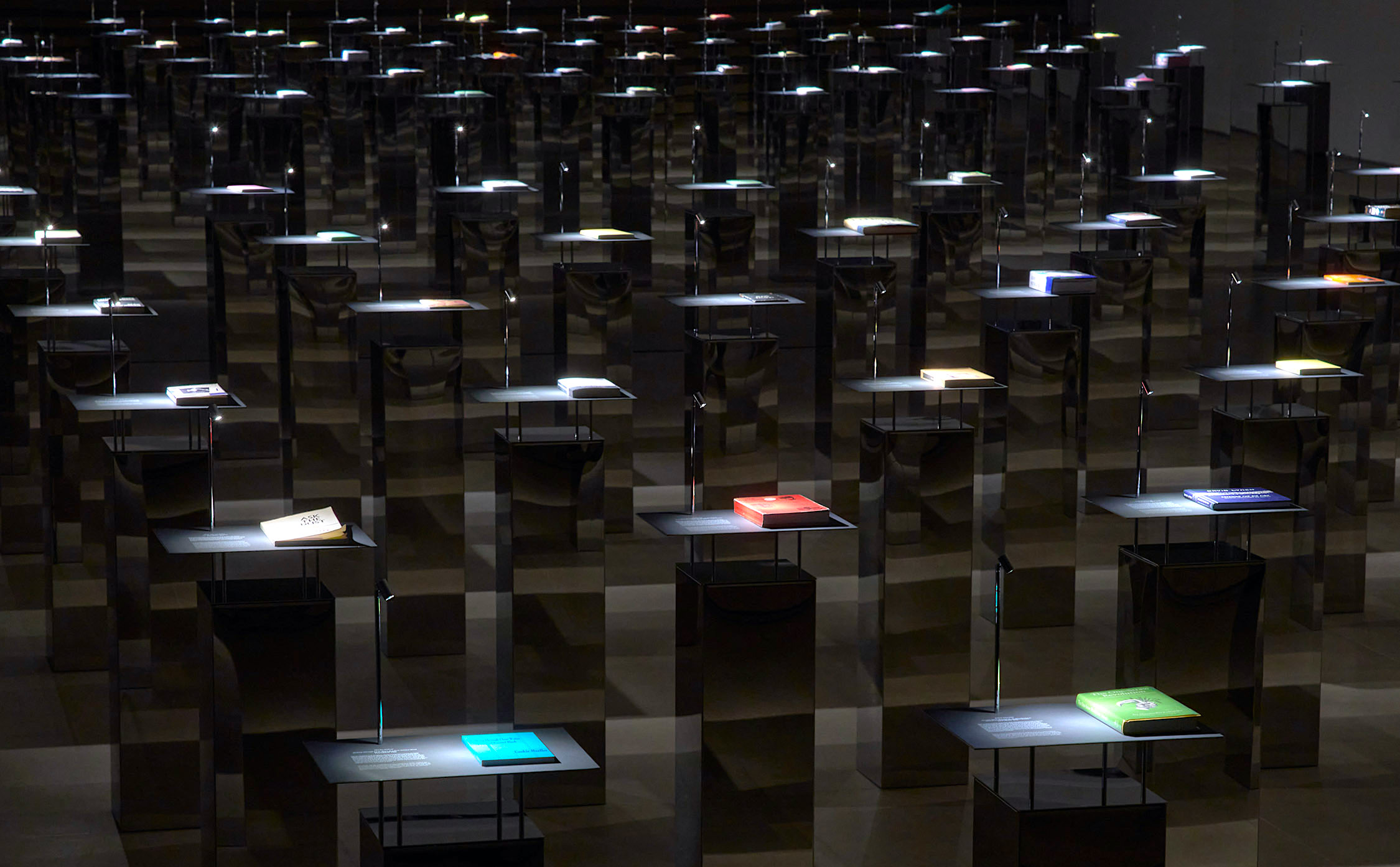
In a bold move, flipping the script on what normally have been Instagram-moment backdrops, Jil Sander set out to inspire visitors to put down their devices and peruse 60 books selected by 60 of its closest prominent creative partners. Ironically, photos of the still theatrical, if pared back, Reference Library installation were posted thousands of times. Both Miu Miu and Prada produced lecture series. The latter did so again with widely celebrated duo FormaFantasma at the storied Santa Maria delle Grazie (home to da Vinci’s The Last Supper). The programme’s theme: a reassessment of the role images play in our society.
Loro Piana delved deep into its own archive to zero in on its long-held expertise in plaids: the use of techniques such as embroidery, jacquard, and quilting in creating this specific pattern. Back within the furniture industry, heritage company B&B Italia presented an exhibit focused on the evolution of its ad art direction. At Salone del Mobile, its booth took on a hyper-modernist Mies Van der Rohe look. Among a comprehensive raft of Trienniale di Milano-recognised designer retrospectives, but also the launch of the first Eames pre-fab home product (still historically cued), Danish textile giant Kvadrat mounted an archive exhibition dedicated to the work and idiosyncratic process of largely unsung Dutch fibre-craft hero Frans Dijkmeijer.


Both American kitchen and bath fixture brand Kohler and Italian fashion house Gucci choose to nod to nature: bucolic garden settings. The former teamed up with California lifestyle entity Flamingo Estate to mount The Bathhouse: “a bold courtyard sanctuary celebrating design, materiality, and wellness.” The latter unveiled tapestries retelling its own history amid a courtyard – layered pasture of specially cultivated seasonal flowers. Like historical reverence, naturalism is always a safe bet.
A Few Other Highlights
Elaborate, scenographic installation has long been a quality of Milan Design Week, and though the approach might have been more soberly deployed at this year’s edition, it was still a defining feature. In addition to all those mentioned before, maverick Murano glass studio 6:AM took over the rationalist Piscina Guido Romano to cleverly display its full range, making use of every spatial element, including shower stalls.


Prolific Belgian duo Muller Van Severen celebrated its 15th anniversary with larger-than-life, geometrically playful candle holders carefully placed across a converted classic Milanese storehouse. Local yet globally active architecture interiors practice Studioboom expanded its office with a new left-raw gallery space, sparingly showcasing its project-derived custom furniture and furnishing solutions. The bold showcase played up visceral material contrasts but also hinted at potential contextualised applications.