
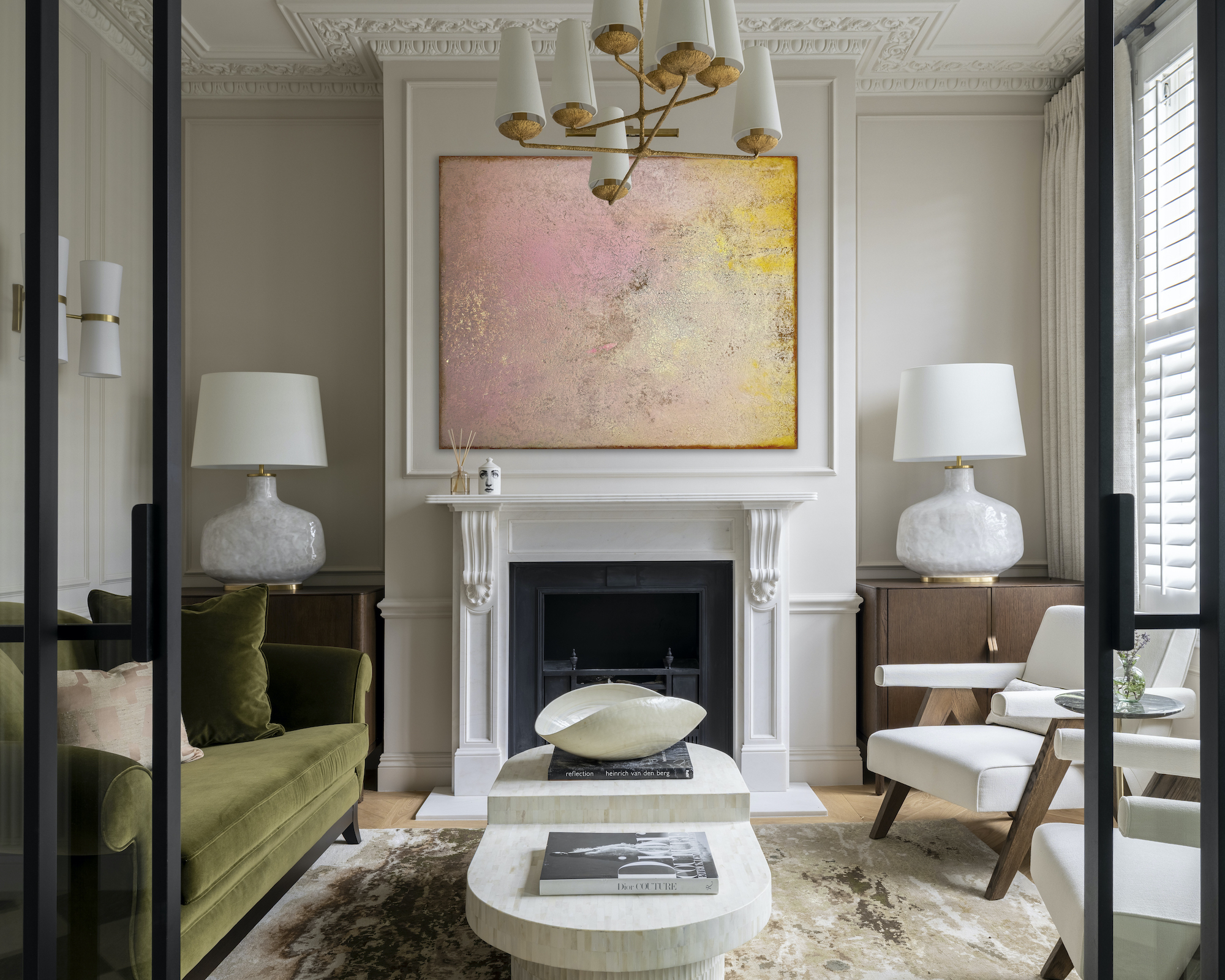
A new London vernacular has emerged in the city’s interiors. We speak to some of the capital’s leading designers to discover what is driving it.
While London’s architecture and interiors have exerted global influence since the Georgian era and beyond, there is a certain feel to the capital’s contemporary spaces that has emerged as a distinct aesthetic in the design landscape – a new vernacular as recognisable as the alpine chalet or Nantucket beach house, if a little harder to define.
To do so, we spoke to some of the UK’s leading interior designers; and while these studios work across the world, their clients often seek them out for a sensibility that feels shaped by London’s culture.


If there is a thread that runs through each designer’s work, it is a close relationship with the building itself. For Saskia Blyth, founder and creative director of Blyth-Collinson Interiors, creating a sense of place “always begins with understanding both the house and the people who live in it.” Rather than applying “a fixed aesthetic,” she says, “the architecture, the history of the building, its location within London, and the way the clients want to live all shape the design.”

At Project London (pictured top), head of interior design Marcelina Janiszewska similarly sees the city’s historic architecture as the defining influence on its interiors. Working within listed buildings and conservation settings means every intervention has to earn its place. “The real skill in London,” she says, “is intelligent space planning rather than cosmetic styling.”
“The real skill in London is intelligent space planning rather than cosmetic styling.”
Marcelina Janiszewska, Head of Interior Design, Project London
As a predominantly Victorian and Georgian city, London’s design language has been shaped as much by necessity as by aesthetics. Unlike properties in Los Angeles, for example, where generous proportions encourage openness and visual drama, London homes rarely offer expansive blank canvases.

Interior designer Rebecca Hughes sees intimacy as one of London’s greatest strengths. “Rooms are frequently compact, ceilings can vary dramatically between periods, and layouts are often dictated by quirky historic architecture,” she says. “Rather than resisting these constraints, we celebrate them – relying on clever storage solutions, finely crafted details, and layered decoration rather than scale for its own sake.”
Janiszewska describes projects where historic, unalterable floorplans force designers to solve problems through geometry and bespoke interventions rather than demolition. “Perhaps the modern London approach is just the art of carefully editing and adapting what is already right in front of you,” she says, giving as an example custom cabinetry tucked beneath an angled staircase.

Ask any of these designers to describe a London interior, and one word recurs: layered. They each detail mixing different periods, objects and influences with remarkable ease.
“Layouts are often dictated by quirky historic architecture. Rather than resisting these constraints, we celebrate them”
Rebecca Hughes
For Hughes, this ability to allow different eras to coexist is a quintessentially London instinct: “A contemporary sculpture might sit comfortably beneath 18th-century cornicing, and sleek bespoke furniture may share a room with French antiques and emerging British art,” she says.
Likewise, interior designer Laura Hammett describes the city’s interiors as “layered, but never cluttered.” Rather than minimalism or maximalism, she identifies “a certain richness” – spaces that are “deeply referential” to English craftsmanship and history, yet use those references “lightly, without pastiche.”


Michael Tyrell of Own London widens the lens further, arguing that London’s status as a global city naturally encourages eclecticism. Contemporary furniture, antiques, international influences and artisanal craftsmanship coexist because London itself is built on cultural exchange. The result is what he describes as “sophisticated eclecticism – historically aware, globally influenced, and full of character.”

TOWNHOUSE: The world’s most elegant townhouses. Published by Cultural Union and available worldwide
Unlike country houses, whose interiors often respond to landscape, London’s homes are shaped by urban life. Tyrell points out that London is “very much a seasonal city.” Homes, he says, “need to feel warm and cocooning during short winter days, while remaining light, comfortable and adaptable during increasingly hot summers.”

Hammett identifies another defining influence: London’s famously soft light. “Our grey skies and diffused natural light reward subtlety,” she says, favouring “tonal and muted” palettes drawn from earthy, historically informed colours rather than brighter, more saturated hues.
Even the long-discussed divide between East and West London appears less pronounced than stereotypes suggest. Hughes observes that while East London may still retain a more experimental edge and West London a refined classicism – both now embrace colour, pattern, and expressive decoration with equal confidence. The boundaries, she suggests, have become increasingly fluid.


Perhaps the greatest distinction between London’s spaces and those elsewhere lies in how they communicate luxury. For example, American interiors often announce themselves through scale and Scandinavian homes through sculptural purity, but London’s finest properties rarely rely on any single gesture.
Instead, as Janiszewska puts it, “luxury is communicated through proportion, tailored craftsmanship and an understated sense of permanence.” Blyth shares a similar view, describing the most successful London homes as “calm, functional and deeply personal,” responding “to the architecture, and most importantly, the people who live there.”

Perhaps the modern London vernacular is less an aesthetic than an attitude: one that values continuity over novelty, craftsmanship over spectacle and personality over perfection. It is a language shaped by centuries of architecture, the realities of city living, and a longstanding willingness to let history and modernity occupy the same room.
It is an attitude that now extends far beyond its own streets. Around the world, people are increasingly seeking homes that feel less designed than deeply lived in. And in that sense, London’s greatest residential export might be its distinctive way of making places feel unmistakably and authentically their own.