
This year’s edition of the ever-established city-wide happening shed showy spectacle for more substantive exhibitions, installations, and launches—with favorable results
With flagship fairs Art Basel Miami Beach and Design Miami (celebrating its 20th edition this year) anchoring a whole host of peripheral happenings, Miami Art and Design Week has quickly climbed the ranks of marquee cultural and commercial events dotting the global calendar. However, this month’s edition was less about the bang of glitzy star-studded parties and exorbitant sales of previous years, and more about moderation and focus. This change in mood didn’t so much signal the looming threat of a bust—an uncertain market egged on by a weary political climate—but a collective call to temper over-saturation and a desire for quality over quantity.


Interestingly enough, this re-adjustment of sorts set the stage for a playful and decidedly optimistic atmosphere, if not also better sales. Paintings that might have gone for $50,000 last year were priced closer to $15,000 this year—yet many more actually sold. Enthusiasm for collectible—or what noted curator and critic Glenn Adamson is now dubbing avant-garde—design also grew. And though fashion brands might not have pulled out all the stops with elaborate displays and celebrity performances, they were still present but in a far more considered way, as were car, beauty, spirits, and even tech brands.
The lines between the disciplines are undoubtedly blurring but the advent of now-overplayed immersive experiences—espousing interdisciplinary collaboration and goodwill but really just promoting product in an about-face way—appears to be fading. If anything, the format is shifting into something less flashy and more applicable, showing the unexpected potential of certain mutually beneficial strategies and not just folly for the sake of folly. Mounted within the storied Wynwood Walls graffiti gallery, kitchen manufacturer Miele’s The Kitchen Muse installation was a monolithic sculpture created by interior designer Luis Fernandez that demonstrated how appliances could be used in unexpected ways, especially in an outdoor context.

Actual cooperation and the sharing of resources has become the new undercurrent, not a contrived flex. One has only to loo at how preeminent furniture fair Salone del Mobile—held in Milan every April—launched a new three-year partnership with Art Basel. For this year’s edition, it outfitted the staple art fair’s collectors’ lounge with various furnishings by leading Italian designers.
Miami Art and Design Week’s offering this year was still enticingly eclectic and visually engaging. While bold public installations cropped up on the beach and the Miami Design District, well-staged dining concepts emerged as part of several hotel-embedded activations. Established galleries opened new outposts, as did leading brands. Contract and high-end residential furniture manufacturers revealed new limited collections and artist collabs. Local museums debut thought-provoking shows.
Bright Tones, Fantastical Forms, and Rationalist Compositions


Bypassing the heavy-handedness of bulky, overly ornate forms all too common as of late, this year’s Design Miami was unquestionably fresh, happy, and playful, yet practical and inventive. There wasn’t anything too bombastic. With an expanded footprint, the 20th-edition fair played host to a growing number of non-gallery exhibitors: maverick producers, carpet companies, and architecture firms putting their own shrewd spin on ‘functional art’ furnishings.

Much of this success stemmed from careful spatial planning. ‘Immersive’ brand showcases—Kohler, Gaggenau, Fendi, and British perfume brand Clive Christian—more constrained and less experiential than in previous years—were positioned along one row. A Land Rover was parked up toward the rear. Blue-chip galleries like Friedman Benda and R & Company were concentrated along the center, and newcomers like specialized French producer Theoreme Editions lined another side.
The latter, a ‘maison d’edition’ start-up, presented the Studio BrichetZiegler Drift Chair collection—pared-back wooden settees imagined as a serene, interplay of form, structure, and ergonomic comfort; a sharp contrast to the bulky, sumptuously inlaid, patinated, and overly decorative armchairs one could find at other booths.

The fair’s curatorial director, Glenn Adamson, mounted a special Design Miami 2.0 capsule showcase highlighting the evolution of this niche sector over the past two decades in six or so distinctive pieces. The exhibit included works byJack Craig and Dirk Van Der Kooij evoking an undying fascination in material experimentation among numerous talents. The through-line of craft-led cultural response was evident in Stephen Burk Man Made’s The Lost Cloth Object assemblage, developed in collaboration with Italian surfaces brand ALPI. Other standout presentations included prolific local architect firm Arquitectonica’s floating lily-like Vadose tables, produced in teak and zinc.
Maverick talent Katie Stout’s fantastical GARGANTUA’S THUMB carousel, replete with abstracted creatures, nodded to those she also installed within the Miami Design District as part of its Design Commission program. An archival bent was apparent in a 1980s-focused showcase mounted by downtown Manhattan gallery Superhouse but also rare early 20th-century pieces on view with prestigious uptown platform Magen H. Mellow yellows, pale oranges, and mid-tone greens carried across the fair.
Luminous Forms on The Beach

Similar tones defined ever-revered Dutch designer Sabine Marcelis’s custom tables for the latest installment of the We Are Ona dining experience program. In the past few years, the platform has tapped notable creatives to mount distinctive installations at unique locales the world over. Hosted within the Andaz Miami Hotel’s beach-facing terrace, the four-night series centered on the monolithic seven-meter-long designs—created out of pink and yellow travertine pedestals fused to matching colored glass tops. These functional sculptures are an iteration of the Beyond The Surface project she first developed with dynamic material supplier SolidNature in 2023.
The staging, the site of many intimate and informal exchanges, brought together a crop of other au courant design brands including BD Barcelona—the STEDELIJK Chair Marcelis also designed—and boutique, Vancouver-based lighting producer Bocci. World famous chef José Andrés crafted lunch and dinner menus. Dishes included Cobia “Pastrami” Crudo with coastal rub, melon, and a mustard vinaigrette, Spanish Octopus with Hazelnut emulsion, and Braised Short Rib with truffled potato puree.
A Sundial Library Signaling Climatic Precarity

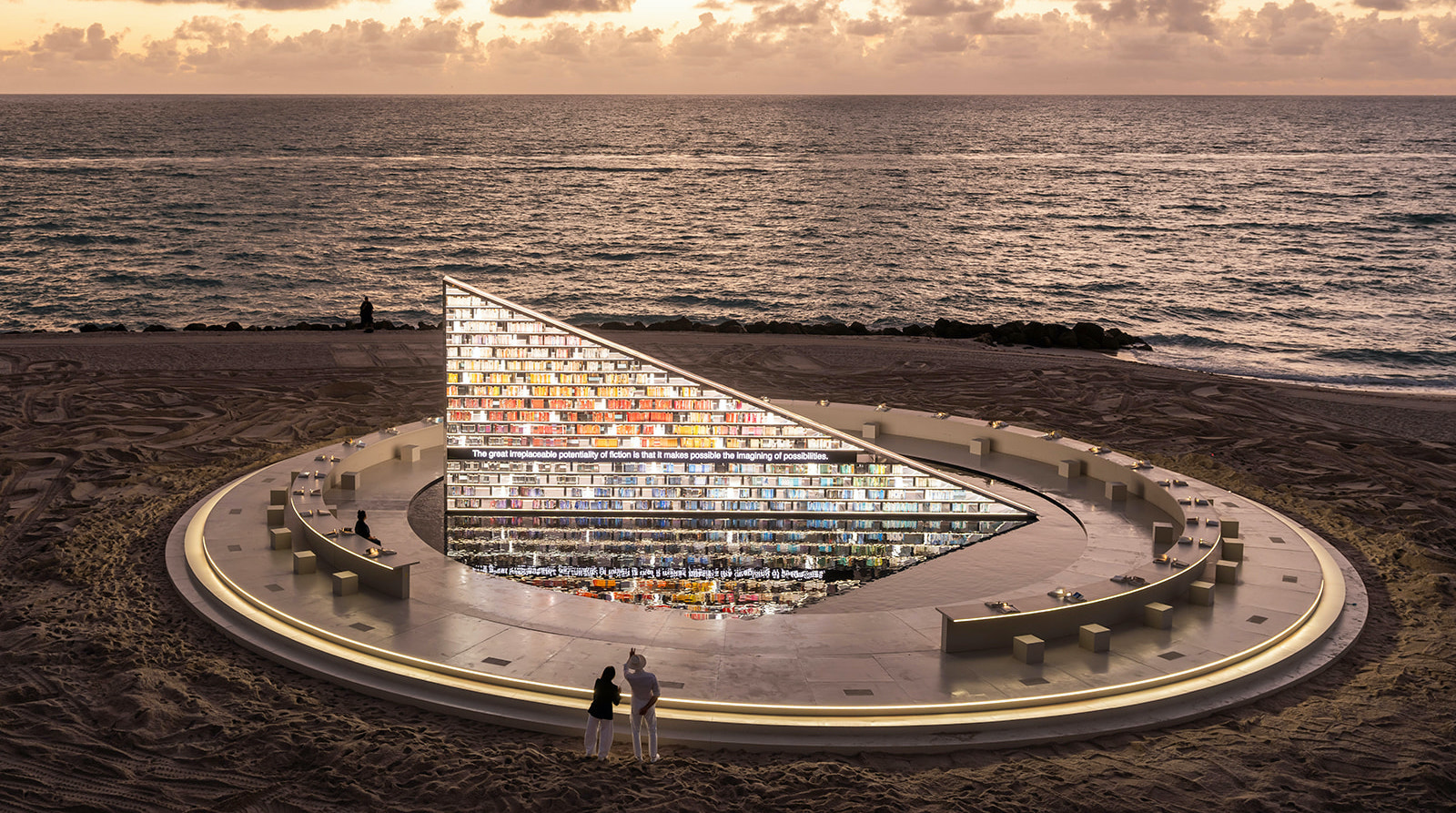
With grand socially minded installations mounted as both viscerally engaging theater sets and interactive public installations, British artist Es Devlin has been making waves over the past decade. Her latest project—the Library of Us—was much more of a sloped sundial than an undulating surge like the previous Library of Light project she created for the Salone del Mobile this April.
Mounted on the beach adjacent to the sprawling Faena resort, the rotating structure sat atop a shallow pool and was encircled by a podium for both “in motion” dinners and book displays. The main tower shelved a wide selection of books and a screen displaying various passages from notable others also recorded by the artist and played-out.
For Devlin, this more refined version of what she first developed in April was both meant to emulate the global melting pot locus point that is Miami, but also its environmental precarity: the paper of the books positioned so close to the ocean water that will rise over and flood the land in 30 or so years.
Experimental Ornamentation in a Haunted House

Ever the deft locator of unique exhibition venues and contextualized “domestic” outposts—extravagant townhouses in Manhattan’s West Village and sprawling mansions in the Hollywood Hills—The Future Perfect just opened its latest site. Situated just north of the now well-established luxury commercial core of the Miami Design District and within the emerging Little Haiti neighborhood, Villa Paula is an iconic, listed hacienda, and not because of its distinctive architecture – though that’s a plus when staging dramatic vignettes.

The 1926-build home is purportedly haunted by its namesake: the wife of a Cuban consulate who resided here early on. The rumor is that she’s buried out back and makes her presence known day and night, even among the hyper-refined pendants of noted lighting designer Lindsey Adelman and extruded ceramic tables of Floris Wubben.
Operated by the gallery for at least three years, Villa Paul was deftly updated as a dynamic backdrop for interchanging displays. Certain “weathered” surfaces were left in their textured and palimpsest state for theatrical effect. Paula’s dark aura pops into photos every now and then.
Soft Forms Rendered in Hard Surfaces

Contract furniture brand Coalesse is the “softer” franchise of powerhouse American manufacturer Steelcase. Its organic, generously upholstered sofa systems bring that all-so-popular touch of residential comfort into the office. These “rounded” designs are normally wrapped in gently textured muted toned fabrics. Shaking things up a bit is revered British design polymath Tom Dixon’s one-off installation, rendering the Jean Nouvel-designed seating series in a Designtex-developed “crinkled metal” printed textile. Dixon is known for instigating such bold instigations. The juxtaposition of sharp iridescent bends and angles against the amoebic forms was both visually and viscerally enticing, revealing what happens when different forces come together and introduce their otherwise divergent style in cohesive outcomes.