
Hotelier James Thomson’s atmospheric and immersive Edinburgh hotels have garnered a dedicated global following. Adele Cardani visits The Witchery and Prestonfield House to discover the artistry behind the myth.
“A waiter is not simply employed – he is cast in a role,” says James Thomson, owner of The Witchery and its sibling, Prestonfield House. “You have to look at the restaurant experience as a whole – like a production.” It’s a comment that reveals much about the operation and design acumen that lies behind these peerlessly atmospheric Edinburgh hotels and the spell they cast on visitors to the Scottish capital.
The city itself wears its history visibly, and the soot-darkened stone and jagged skyline do much of the work before arriving at either of Thomson’s Edinburgh hotels. The Witchery and Prestonfield House sit at opposite ends of the city’s emotional spectrum. One clings to the gates of the Old Town like a theatrical secret, the other withdraws into its own acreage of lawns and trees. Yet both are expressions of the same conviction: that immersive design is no longer a decorative flourish, but the organising principle of a good stay.

The Witchery announces itself obliquely. Visitors pass beneath the looming presence of Edinburgh Castle, through a knot of tourists and bagpipers; and suddenly there is a door, heavy and discreet, set into Castlehill. The name carries its own weight – this is the site of the city’s witch trials, where hundreds were burned at the stake, and the building seems determined not to forget it.
“A waiter is not simply employed – he is cast in a role.”
James Thomson, owner of the Witchery and Prestonfield House
Inside, the mood is unapologetically gothic. Dark and dense oak panels, tapestries and heavy curtains soften the edges, and candles burn low – even at breakfast. Light is rationed, and when it comes, it arrives filtered through stained glass or reflected from polished silver. This is not a hotel that courts daylight.

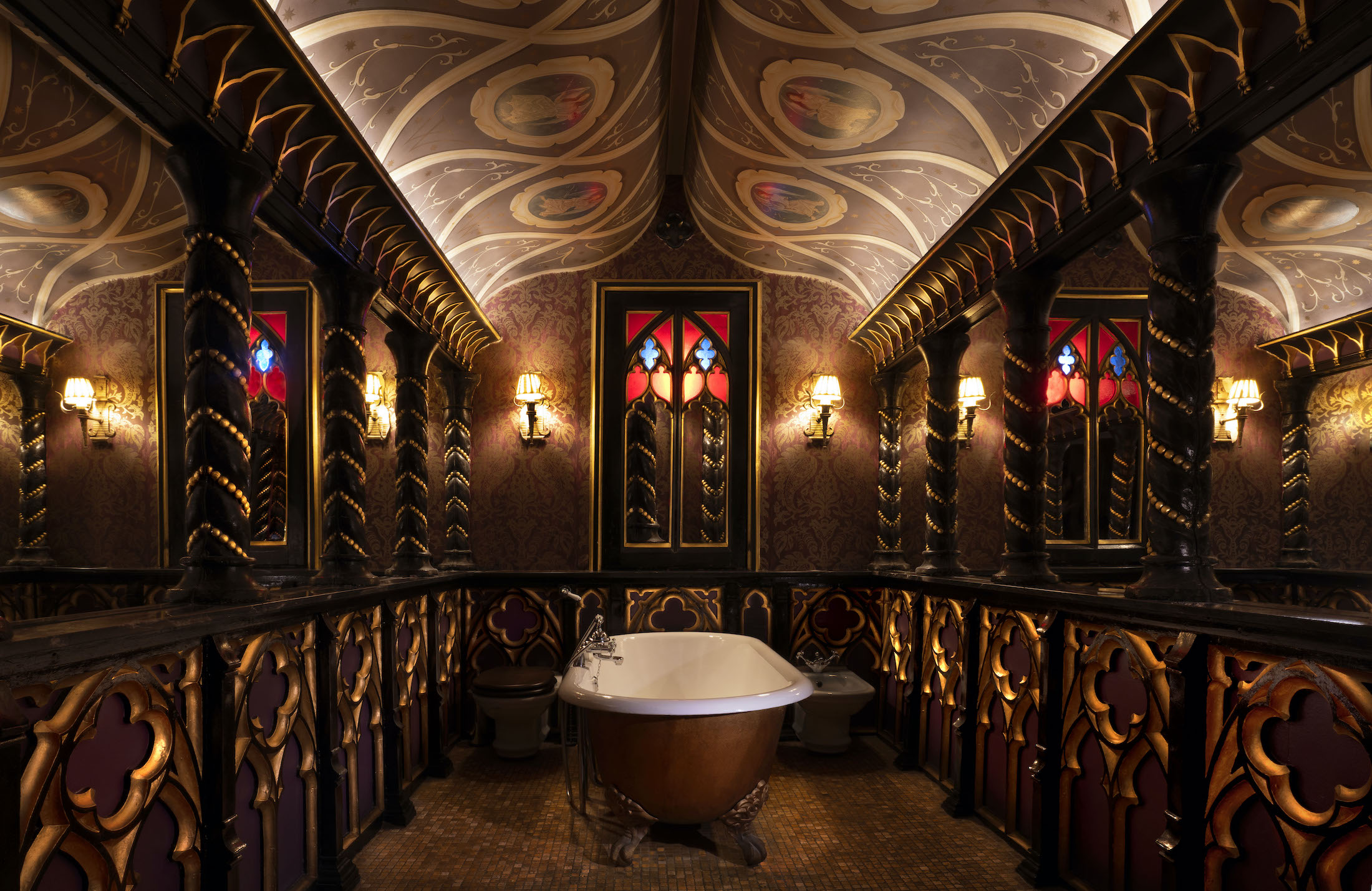
What is striking is not just the theatricality but the confidence with which it is sustained. Each of the nine suites is composed as a dense, deliberate world: four-poster beds, velvet upholstery, gilt-framed mirrors, and walls lined with antiquarian books. The bathrooms extend the same logic of indulgence – hand-painted ceilings and colossal clawfoot tubs.

What The Witchery achieves, above all, is a rare consistency of mood. The building does not just reference history – it inhabits it, and every surface works toward the same effect. There is a story-laden energy to the place that at times feels almost watchful. This is immersive design at its most persuasive: not a mere display of costly objects, but an atmosphere so controlled it begins, almost unconsciously, to dictate how you move and speak within it.
Prestonfield House, by contrast, opens outward. Set within expansive grounds just beyond the city, it presents itself as a grand country estate that happens, incidentally, to accept guests. A long drive peels away from the urban edge, and by the time the house comes into view, the noise of Edinburgh feels improbably distant.

Here, the interiors lean classical rather than Gothic, but no less assertive. Rooms are lined with damask wallcoverings, oil portraits in heavy frames, and chinoiserie lamps that look as though they might have been assembled by an avid collector rather than a designer. The palette is cheerier, the light more generous, but the effect is similarly enveloping.
Prestonfield’s genius lies in its balance between grandeur and intimacy. The scale is unmistakably aristocratic – high ceilings, long corridors, formal dining rooms – but the furnishings resist museum stiffness. Chairs are meant to be sat on and desks still bear the faint marks of use. The grounds extend the experience outward: Highland cows and peacocks wander across the lawn; the city’s skyline appears and disappears between trees. It is a reminder that luxury, at its best, is spatial as well as material.


Thomson reports first visiting and falling in love with Prestonfield House in childhood. “From a young boy with a dream,” he says, “it has been a real privilege to spend my life creating memorable experiences that celebrate Scotland’s heritage, individuality, and a true sense of place.” Now Scotland’s best-known restaurateur and hotelier, his career has been committed to the idea of hospitality as an art form, and he has gravitated towards properties where architecture is not background but protagonist.

What unites these two very different hotels is their longstanding resistance to prevailing grammars of contemporary luxury. More importantly, they illustrate how immersive design has shifted the terms of the conversation. The focus is no longer solely on visual pleasure, but on multi-sensory experience: the way light falls at dusk, the weight of a door, the echo in a spiral stairwell, the smell of wood and polish. These are emotional cues as much as aesthetic ones. They do not just decorate a night’s sleep; they construct a memory.


In a global hospitality market not short on extravagance, The Witchery and Prestonfield are a reminder of the primacy of imagination, and that when design and operation feed into an authentic and committed narrative, hotels can do more than house us – they can take us somewhere else.
“To see The Witchery and Prestonfield evolve into internationally recognised destinations is incredibly humbling.”
James Thomson
Thomson describes his role as owner and restorer of two of Edinburgh’s most iconic A-listed properties as a “journey that has been nothing short of extraordinary.” He adds: “To see The Witchery and Prestonfield evolve into internationally recognised destinations is incredibly humbling.”