
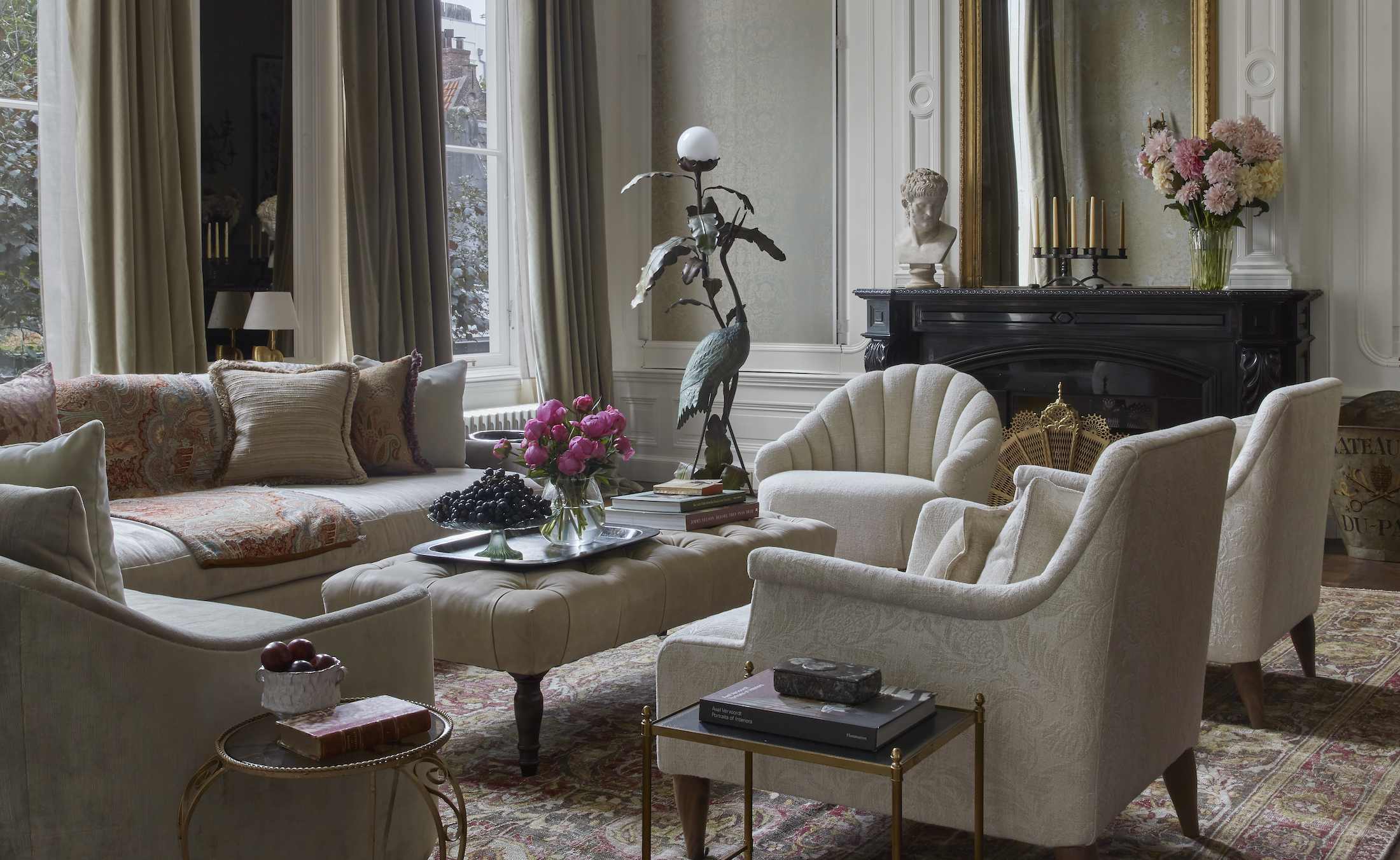
Vicky Charles, co-founder of Charles & Co, speaks to Cultural Union about her studio’s recent renovation of a historic Amsterdam canal house, which features in our book Townhouse.
Vicky Charles is a distinguished British interior designer and co‑founder of Charles & Co, the design studio she launched with Julia Corden in 2016. For two decades prior, Charles served as the global head of design for the Soho House group, shaping their era-defining home‑from‑home aesthetic – and as a result, Charles has probably had as much influence on contemporary interior mores as any designer alive.
It’s all the more impressive, then, that her second act has seen such auspicious creative work. Charles & Co is renowned for creating spaces that feel lived-in from the moment one enters – soulful rooms, classically proportioned, designed to put people at ease. The firm, with offices in New York, Los Angeles, London, and Italy, is discreet, yet counts the Clooneys, the Beckhams, Emma Stone and Harry Styles among its clients.


One of the studio’s most stunning recent projects is a tall, 17th-century canal house in Amsterdam. “It was buried,” says Vicky Charles, of the enchantingly beautiful hallway. “It had been a white-lacquered unit with office lighting. The floor was covered up and the door had been moved. Our first task was putting the house back to how it was originally intended.”
“It’s about listening to it. Once you get to a stage in a project where they’ve stripped everything back and you see what the actual bones of a house are, that’s when you can consider what you want.””
Vicky Charles, co-founder of Charles & Co
Charles recount how the client is British, but lives in Amsterdam, and wanted a house large enough for his children and grandchildren to visit. “He was wonderful to work with – he has opinions, trusted the process, and didn’t want anything to be ostentatious. The house had to be comfortable across generations.”


Now restored, the entrance hall has the serene grandeur particular to Amsterdam’s canal houses. But the process was painstaking. “It’s a 17th-century house, so there have been many layers,” she says. “You have to consider which of those eras to respect.”
Charles describes this in intuitive terms: “It’s about listening to it. Once you get to a stage in a project where they’ve stripped everything back and you see what the actual bones of a house are, that’s when you can consider what you want.”

For example, decades of paint were removed from the bannisters that wind up through the house. “The handrail is so beautiful,” says the designer. “It was incredible to uncover these layers of history, so we decided to leave fragments of old paint.”
The first-floor reception rooms demonstrate Charles’s skill in creating spaces that feel authentic and lived-in. The panels and ceiling details are original and restored, and Charles brought in the specialist company Twigs to do the in-panel papering – a reflective gold on a subtle sage-green.

A connecting reception room houses an exceptionally tasteful home bar area. The bar itself is an antique piece from the Dutch dealer Piet Jonker. “We went there looking for lighting and flooring. And the bar was there – it was one of the earliest pieces we found,” says Charles. The antique mirror was sourced from the British gilder and restorer Rupert Bevan, and the chair is a George Smith.
Fixed lighting was sourced to be period-appropriate, augmented with antique and vintage floor and table lights. “Then we added some contemporary pieces so it doesn’t feel like a museum, which I think is key,” she says. Pieces such as the flamingo light and the bust on the original fireplace were all found in Amsterdam. “You want the house to be filled with things that would have been there and sourced locally. It’s like a treasure hunt.”

The principal bedroom is notable for its stunning grey- blue custom mohair headboard. “Beds are tricky if they’re not custom because you want the headboard to be proportional to the ceiling height, the wall height, and to fit in with everything else,” says Charles. “It’s the most important thing in the room.”
For the colours, however, Charles works from the floor up. “I’ve always found it easier to start with the rug, because you can source any velvet or mohair for a sofa in the right colour. It’s much harder to do it the other way around.”
“You want the house to be filled with things that would have been there and sourced locally. It’s like a treasure hunt.”
Vicky Charles
The bathrooms are notable for their exceptional marble. “Our European design director, in our Italian office, is incredibly passionate about marble,” says Charles. “It’s a great resource to have in the company.” Charles visited the marble yards around Lake Garda, where the marble for the house was sourced: Ombra di Caravaggio in the main bathroom, Fior di Pesco in another, Calacatta Viola in the red-veined shower, and Rosso Levanto in the downstairs cloakroom.

One of the remarkable qualities of the house is that it is beautifully realised, yet never smothered – as if it has been left room to breathe. Charles has said that she aims to get a house to “seventy percent completion” – leaving space for the client to make it their own.
“You need to live in it a bit before it can be called finished – to work out where you like to have your coffee in the morning, where you like to sit.”
This article first appeared in different form in the book Townhouse, published by Cultural Union, available in good bookstores worldwide