
As Principal of Liaigre and the studio’s Head of Yacht Design, Guillaume Rolland has shaped some of the world’s most notable superyacht interiors. He talks to Cultural Union about his lifelong love of sailing and why the principles of classical architecture should always come before aesthetics.
When Guillaume Rolland, Principal and Head of Yacht Design at Studio Liaigre, recently revisited Rosehearty (the yacht his studio designed two decades ago for Rupert Murdoch), he was able to note that “it was not out of fashion – it was timeless, perfectly maintained, a real pleasure to use.”
This was not a surprise to Rolland; rather, it was the natural result of a design philosophy that addresses the challenges presented by a project with a logical architectural solution. Given the unique parameters of each scenario – flow, positioning, lifestyle requirements – it is the only solution that makes sense, and fashion doesn’t come into it.


While Rolland applies this classical architectural approach to all Liaigre’s spaces, he also has a major advantage when designing yachts: he is a lifelong sailor with an intuitive understanding of the exigencies of onboard living.
“When you look at a yacht on flat water, everybody thinks it’s a floating mansion, but it’s not at all,” he says. “When you race a 43-footer, you face down the difficulties of ergonomics, space and flow in order to become super-efficient in every gesture. With big yachts, everybody is convinced that they don’t move – but they do. If there are strong winds or heavy conditions, you can fall. Even a huge ferry can be uncomfortable in rough weather.”

Published by Cultural Union, available worldwide
Rolland’s approach is to consider the key essentials built into smaller yachts and apply them on a larger scale. “It’s practicality first. In a small space, you can’t afford to be inefficient with flow, layout and position,” he says. “On a racing yacht, every item is precisely placed – if it’s 10 cm away, you lose time. A sailing yacht is a proper machine where nothing is placed randomly.”
When the Liaigre team works on an interior – whether land-based or at sea – they use the same principles. “When we sketch a room, we draw dashes to highlight where people will walk – the route between doors and all the behaviours of people using this space. When you see the space remaining, you put your furniture into that space. Good architecture is driven by what you will not see. It determines what you feel. Architecture is a work of emotion.”

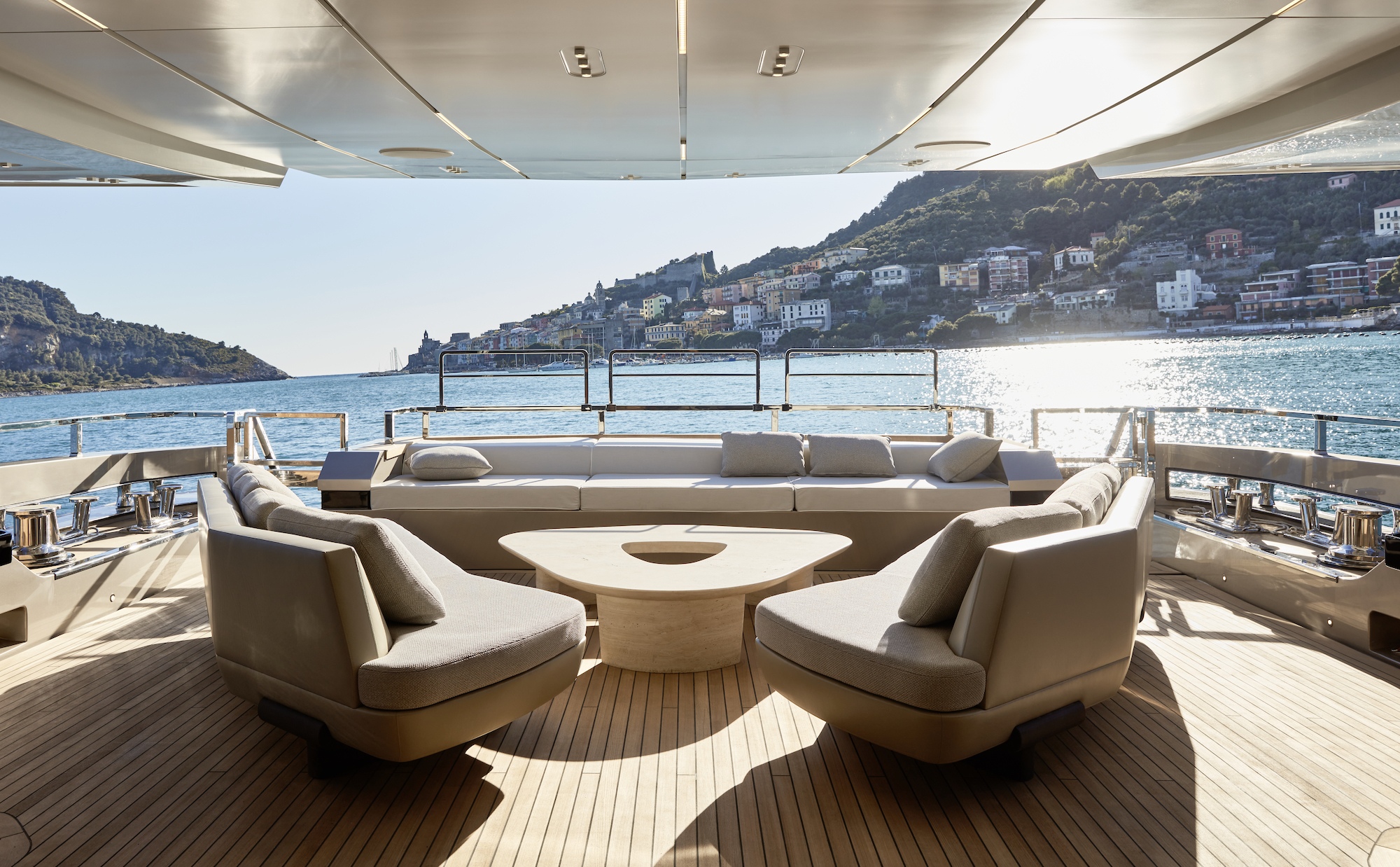
This ethos is evident in the stunning Sanlorenzo SL44 designed by Liaigre for a Singaporean client. The brief, recalls Rolland, was short: the owner wanted an Asian-style interior with a French touch.
“We worked with this duality between two worlds, and we created a contrast between them,” says Rolland. “The dark eucalyptus was a reference to Asia – a glossy, beautiful surface which reflects the sea and creates a glittering light when the sun is low.”
“Yachting is one of the very last freedoms.”
Guillaume Rolland, Principal and Head of Yacht Design, Liaigre
For the French dimension, which Rolland frames as chic and low-key elegance, the studio employed super-matt light elm that recalls 18th-century nautical woodwork. “Those two worlds placed together make a fantastic dialogue with a strong expression of architecture,” he says. “This was the key driver.”

The beauty of Liaigre’s approach is that, having defined this palette as the most rational and elegant response to the brief, the design itself becomes a matter of architectural logic within the parameters of the required flow and usage of space. “The work is done step by step. We look at the plans. We identify what’s problematic in the space,” Rolland explains. “What do we need to solve in terms of flow, connection, transition, storytelling and progression? We deliver an answer – a special answer – which solves it. It’s just doing good architecture.”
One such challenge requiring an elegant solution lay in the SL44’s cabin layout. “This model is one of the only yachts that has three levels of cabins,” he says. “There was a big issue with flow in the entry layout. It wasn’t working, so we repositioned the stairs.”
This single decision dramatically changed the proportion, flow and potential, leading to what Rolland describes as “a 50% improvement in the space.” The designer likens this diagnostic approach to a chiropractor fixing a back: “Just a little tweak and bam – everything works. We are space doctors.”

With the flow optimised, the fundamentals addressed and an architectural rigour applied throughout the boat, the finishes have a natural harmony, allowing the materials and detailing to provide the emotional register. In the main saloon, crystal terrariums introduce a note of Asian symbolism, while on the aft deck, a Modernist armchair expresses pure French glamour. Glossy window blinds lend tropical romance, while the water-skimming beach club is cool and contemporary. Each space offers its own relationship to the sea, yet all are bound by the same underlying logic of movement, proportion and use.
It is here, in this balance between precision and pleasure, that Rolland locates the essence of the studio’s work on the SL44 and also of the fundamental allure of sailing. “Yachting is one of the very last freedoms,” Rolland says. “You own your oil, you go.”
Two decades after Rosehearty, Liaigre’s design remains timeless because it is built on a complete understanding of how people move, live and feel at sea.
This article is an excerpt from SUPERYACHT, published by Cultural Union, available worldwide