
As Brussels prepares to play host to the 70th edition of the prestigious BRAFA art and design fair, we preview the highlights to look out for and the event’s main themes.
The 2025 edition of BRAFA looks set to be a landmark event, with the leading European art and design fair commemorating its 70th anniversary amid the centenary of Art Deco, a movement that continues to be a mountain range in the psyche of design and architecture. Delivered through the prism of the distinctive Belgian aesthetic that BRAFA has long championed, this year’s fair showcases 130 galleries from 16 countries, underscoring its storied past and ongoing contemporary relevance.
BRAFA’s ability to balance the universal with its uniquely Belgian character is a major part of its appeal and is exemplified by some of its star exhibitors. These include BRAFA veteran Axel Vervoordt – the globally celebrated tastemaker whose influence has shaped the fair’s evolution since 1976 – and BRAFA newcomers Objects With Narratives, whose dazzling Sablon gallery perfectly symbolises the elevated position art and design hold in Belgian culture.


This year, Art Deco’s centenary adds spice to the mix, shining a spotlight on Belgium’s pivotal role in the movement. Belgian pioneers such as Victor Horta and Philippe Wolfers were instrumental in defining the Art Deco aesthetic during the 1925 International Exhibition of Modern Decorative and Industrial Arts in Paris; and BRAFA 2025 will host a special talk by Werner Adriaenssens, delving into the history of Belgium’s contribution to what would rapidly become a global phenomenon.
Elsewhere, highlights include a tribute to the late Belgian sculptor Jean-Pierre Ghysels, presented by Galeries AB & SA, and installations by this year’s guest of honour, the Portuguese artist Joana Vasconcelos. Amid a field crowded with gems, here are 10 exhibits at BRAFA Art Fair 2025 that are not to be missed:
Joana Vasconcelos (Galerie La Patinoire Royale Bach)

Portuguese artist Joana Vasconcelos is BRAFA’s guest of honour this year. Lisbon-based Vasconcelos is known throughout the world for her large-scale textile installations and monumental sculptures, with recent collaborations including Dior. The works she is exhibiting this year are intended, she tells us, “to not only celebrate the fair’s rich heritage but also to engage in a dialogue with the contemporary moment, creating an atmosphere that resonates with the depth and vision that BRAFA embodies.”
Ben Storms: Ex Hale Table, 2020 (Objects With Narratives)

For anyone visiting BRAFA, it would be remiss not to also drop into the Objects With Narratives showroom in Brussel’s Sablon – a stunning townhouse and equally stunning showcase for featured artists such as Lionel Jadot, Vladimir Slavov and Ben Storms, whose monumental marble ‘cushion’, pictured, is a contemporary classic. This is the exciting young gallery’s first year at BRAFA, and they are certain to make an impact.
READ: How Objects With Narratives became one of the world’s most exciting galleries
Louis Malard: Monumental bed in Egyptomania style, c. 1889 (Galerie Marc Maison)

Galerie Marc Maison has a reputation for bringing showstoppers to BRAFA – last year, they wowed fairgoers with a complete Art Nouveau room by Victor Horta. This year, they are bringing an Egyptomania theme to the fair, which promises to be another crowd-drawer. The highlight of the exhibition will a Ramses bed by cabinetmaker Louis Malard, which was presented at the 1889 Paris Exposition.
Bodil Kjaer: President Desk, 1959 (Gokelaere & Robinson)

BRAFA mainstays Gokelaere & Robinson, based in Knokke and Paris, consistently exhibit one of the strongest collections of mid-century design and art. This year, they are showing an exceptionally pretty Max Ingrand table lamp from 1955 for Fontane Arte and a 1958 Poul Henningsen artichoke pendant lamp in oxidised copper. Pictured here is an example of the kind of refined mid-century Danish work that the gallery is known for, and that did so much to make Danish design such a 20th-century benchmark – a 1959 desk by Bodil Kjaer. Her credentials are impeccable: the famed Marcel Breuer installed 28 of her pieces in a building he had designed in New York.
Wilhelm Leibl: Study of a Skull, c. 1868 (Colnaghi)

Colnaghi might be a newcomer to BRAFA but is reputedly the oldest commercial art gallery in the world, founded in 1760 in Paris before moving to London in 1785 – where they are currently headquartered. In addition to outposts in New York and Madrid, Colnaghi have recently expanded to Brussels, where Philippe Henricot leads a new space with an exceptional collection of old masters. Exhibiting at BRAFA this year will be Study of a Skull, circa 1868, by Wilhelm Leibl. The white drape transforms the skull – a traditional symbol of death – into a portrait; and Henricot describes how the painting marked a turning point in Leibl’s career, with the artist subsequently becoming one of the 19th century’s most important German portraitists.
Jef Verheyen: Vendemia Eterna, 1982 (Axel Vervoordt)

Gallerist, curator, interior designer – Axel Vervoordt is one of Belgium’s titans of design and art, with a compound in Kanaal that is to art what Willy Wonka’s chocolate factory is to lovers of confectionary. Jef Verheyen (1932–84), who has long been championed by Axel Vervoordt, was a major Belgian artist whose studies in light and colour look every bit as striking and contemporary now as they did in his mid-century heyday. Pictured is 1982’s Vendemia Eterna (Magie du Vin), oil on canvas
Fox And Hare on a Floral Ground, 16th century (De Wit)

Based in a 15th-century refuge house in Mechelen, Belgian tapestry atelier De Wit has been at the forefront of weaving since 1889 – though they now specialise in trading, conservation and restoration (with clients including the V&A, the Louvre and the Rijksmuseum). Images do not do justice to the rich detail and colouration of these centuries-old tapestries, so the museum-level De Wit stand is well worth the visit. Pictured here is an example of the ‘millefleurs’ tapestries produced in Bruges and Enghien in the sixteenth century, which were highly valued for both their decorative and symbolic aspects.
Songye Mask, Democratic Republic of Congo, c. 1900 (Claes Gallery)

One of the things that marks out BRAFA is the exceptional quality of traditional African art and artefacts – and Brussels-based gallerist (and BRAFA vice-chairman) Didier Claes has been a trailblazer in this field. Pictured is a female ‘kikashi’ mask from Katanga, Democratic Republic of Congo, which would have been used on the death or investiture of a chief, or during lunar rites.
Serkan Cura: Feather Cabinet, 2020 (Maison Rapin)

Paris gallery Maison Rapin focuses on French and Italian decorative arts, and last year’s stand dazzled with a 1972 Marc Cavell Op-Art and a stunning mustard-yellow 1962 Marco Zanuso sofa. This year’s highlights include a 1980 crystal and coral chandelier by Robert Goossens and (pictured) the Feather cabinet, adorned with 7,500 fans created from “naturally shed” rooster feathers by Serkan Cura – who also creates haute couture for Jean-Paul Gaultier.
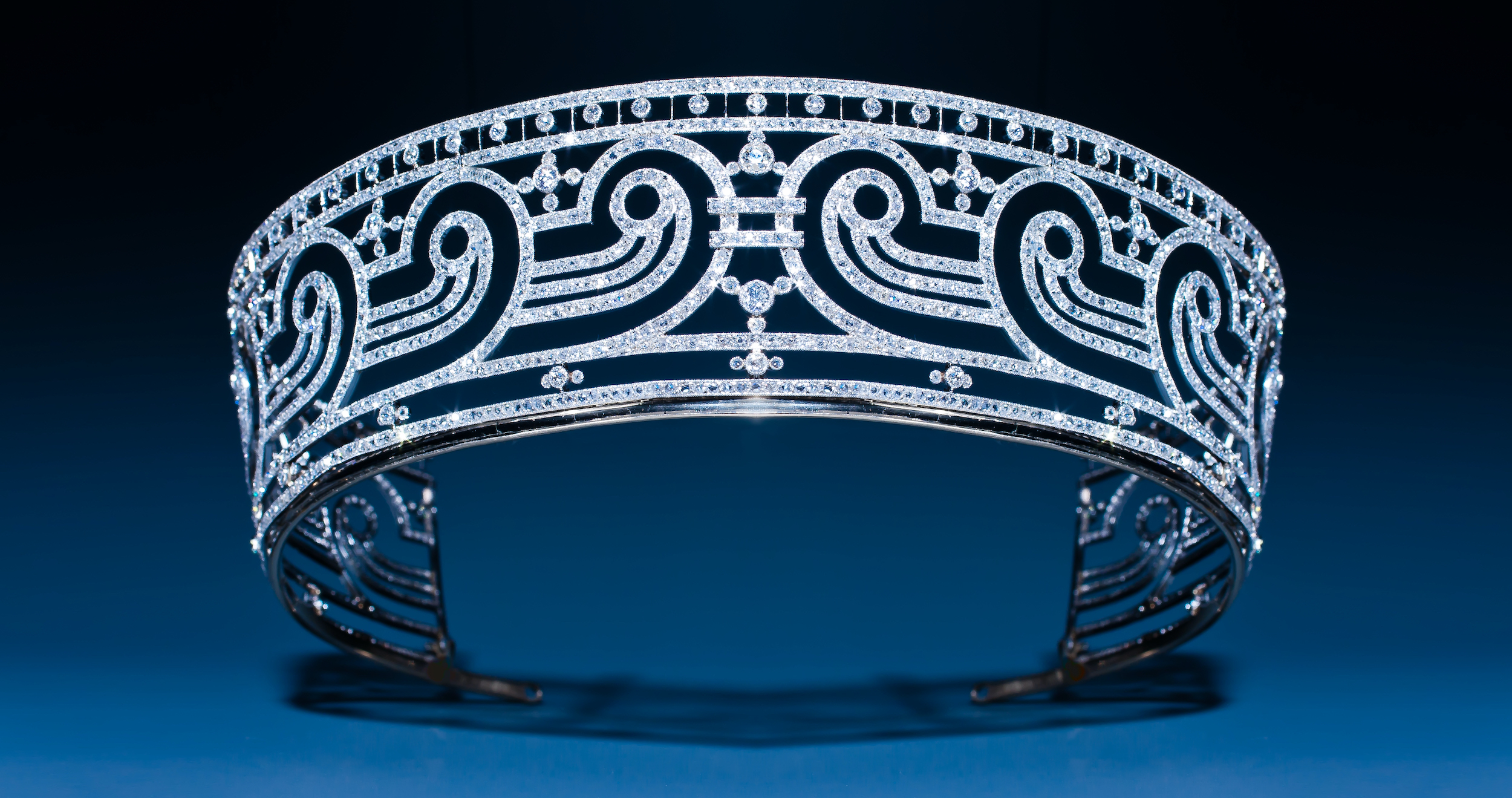
Chaumet: Tiara, 1909 (Epoque Fine Jewels)

While predating Art Deco by a decade or more, the Greek-inspired motifs on this platinum, gold and diamond tiara by Chaumet, presented by Belgium’s Epoque Fine Jewels, are an early example of the geometric aesthetics that would define the Art Deco period. Created as a wedding tiara for the daughter of Count and Countess de Heeren, the piece is set with 2,096 diamonds.
BRAFA, 26 January – 2 February 2025 at Brussels Expo, Place de Belgique 1, 1020 Brussels